HALLE INTERNATIONAL
Off plan & New Build Properties
New Build
Buying in France
VEFA
Personalisation
Personalising Your New Build property
Buying off-plan in France gives you a window of opportunity to personalise your property before it is built. Here is exactly what is possible, how to request it, and what limits apply.
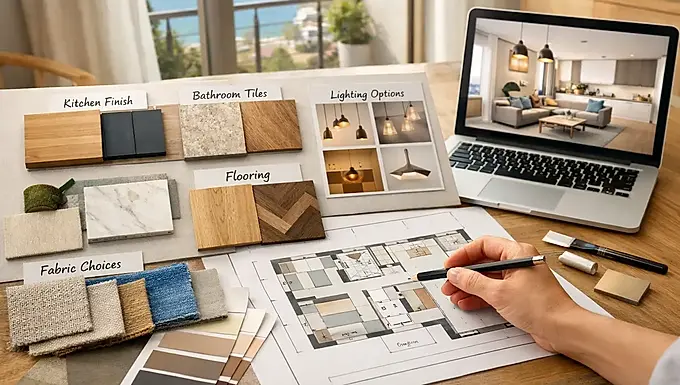
The Off-Plan Advantage You May Not Know About
One of the lesser known advantages of buying a new build property in France under VEFA is the ability to influence how your property is finished before construction is complete. Unlike purchasing a resale property where you inherit whatever the previous owner chose, an off plan VEFA purchase gives you a defined window in which to make changes to the layout, the finishes, the fixtures, and the interior configuration before the building is handed over.
These modifications are known as Travaux Modificatifs Acquéreur, or TMA (Buyer pre-completion Modifications). They are a formal mechanism within the off plan VEFA framework that allows buyers to request changes to the standard specification of their apartment, villa or chalet, subject to the developer’s approval, compliance with building regulations, and the timing of the construction programme.
Understanding TMA, what they cover, how to request them, and when they are likely to be accepted or refused is an important part of buying off-plan in France, and particularly relevant for international buyers who may be accustomed to different levels of customisation in their home markets.
💡 What is a TMA? Travaux Modificatifs Acquéreur (TMA) are formal buyer-requested modifications to the standard specification of a VEFA new build property. They must be agreed in writing with the developer, comply with all applicable building regulations and the terms of the permis de construire (Planning Permission), and be submitted before construction reaches the relevant stage. TMA are distinct from the standard options and finishes menu (notice descriptive) that most developers offer at reservation, which typically carry no additional cost.
What You Can Change Before Completion in a French VEFA Purchase?
Interior Layout and configuration
The most significant category of TMA concerns the layout and configuration of the property. Depending on how early in the construction cycle your request is made and the structural constraints of the building, it may be possible to remove or reposition non-structural internal partition walls, modify the position of internal doors, or adjust the size of rooms for example, merging two spaces into one, or reconfiguring a bedroom and en-suite arrangement.
For buyers of luxury alpine chalets and larger Riviera apartments, this type of modification can be especially valuable: aligning the layout with specific lifestyle requirements, creating a more open-plan living area, or ensuring that the principal bedroom suite is configured as intended from the outset.
⚠️ Structural constraints apply: Not every internal wall can be removed. Walls that form part of the structural frame of the building, or that carry utilities such as electrical ducts, plumbing risers or ventilation channels, cannot be repositioned without implications that would typically place them outside the scope of TMA. Developers will not approve modifications that affect the structural integrity of the building or the common parts (parties communes) of the residence.
Finishes, Surfaces and Materials
Most developers offer a catalogue of standard finishes like flooring, wall coverings (Paint, wood or Stone), tiling from which buyers can select. In many high-end developments, the ability to choose from this catalogue is included in the purchase price. For buyers who wish to go further, selecting finishes outside the standard range, upgrading to a higher grade of material or specifying a bespoke tile or floor product, this is typically possible through TMA, subject to a supplementary cost.
Common finish modifications include: the choice of floor covering by room (engineered oak, large-format tile, natural stone), tiling specification in bathrooms and wet rooms, the height and finish of internal doors, and the selection of sanitary ware, taps and shower fittings within an agreed range or from a supplier list approved by the developer.
Bathroom and Kitchen Configuration
Within wet rooms and kitchen spaces, a useful range of practical modifications is typically available. In bathrooms, the most common request is to substitute a bath for a walk-in shower, or vice versa, a change that affects both the plumbing layout and the tile specification. The positioning of the shower enclosure, the choice of a standard or recessed shower tray, and the location of a heated towel rail are all commonly accommodated in the early stages of construction.
In kitchens, buyers may be able to request the repositioning of the sink or principal appliance connections, the addition of a kitchen island where the floor plan permits, or adjustments to the drainage and extraction infrastructure. Note that the majority of off-plan French Riviera apartments are delivered without kitchen furniture (cuisine non équipée). French Alps developments, by contrast, are most commonly delivered with a fully fitted and equipped kitchen, meaning TMA requests in alpine properties more often focus on the choice of units, worktop material, appliance specification, or layout configuration within the kitchen space.
Electrical, Lighting and Technology Infrastructure
The positioning and number of electrical sockets, data points, lighting circuits and switches is one of the most requested categories of TMA and one of the most straightforward to accommodate in the early stages of construction. Additional socket positions in a home office space, a dedicated circuit for a home cinema setup, repositioned light switch plates, or low-voltage lighting circuits can all typically be arranged before the electrical first fix is completed.
For buyers who intend to install home automation or integrated systems at any point, this is the critical moment to ensure that the cabling infrastructure is in place. Retrofitting structured wiring, speaker cabling or motorised blind wiring after completion is significantly more disruptive and costly than specifying it at TMA stage.
💡 Smart buyer tip: If you plan to install home automation, a home cinema, motorised blinds, or integrated audio even if you are not yet committed to a specific system raise it at TMA stage. The cost of running the cable infrastructure at first fix is a fraction of the cost of retrofitting it after handover. Ask Halle International what they are able to pre-install as standard, and what requires a formal TMA request.
How to Request TMA: The Process
Timing Is Everything
The single most important factor determining whether a TMA request will be accepted is timing. Most developers require all modifications to be submitted within a defined window following signature of the Contrat de Réservation typically four weeks. This deadline exists because construction development management is complex: even small modifications to one apartment can have knock-on effects on materials orders, site scheduling and adjacent units.
For buyers who have not finalised their requirements at reservation, the best approach is to flag areas of interest to the developer immediately after signing and to submit formal TMA requests as early as possible within the permitted window. Do not wait until you are certain, raise the question early, as developers will often provide indicative costs and feasibility assessments before you are required to commit.
The Formal Request and Approval Process
TMA requests are submitted in writing to the developer (promoteur), who then assesses technical feasibility, compliance with the planning permission and applicable regulations, cost implications, and the impact on the construction of the development. The developer is under no legal obligation to accept a TMA request and may decline on any of these grounds.
Where a request is accepted, the developer issues a formal quotation (devis) setting out the cost of the modification, any timeline implications, and the conditions attached. The buyer must formally approve the devis before the modification is instructed. Accepted TMA modifications are documented as an amendment to the Reservation contract and form part of the full purchase record.
The cost of TMA modifications is typically settled at the time of the Acte de Vente VEFA, the formal off-plan sale deed signed before a notaire rather than upfront at request stage. Buyers should ensure that their budget planning accounts for TMA costs in addition to the purchase price and notaire fees.
Stages | What Happens |
Reservation (Contrat de Réservation) | Raise all areas of interest. Submit formal TMA requests or request feasibility assessment from developer. |
TMA window (typically 4 weeks post-reservation) | Developer assesses technical feasibility, regulatory compliance and cost. Provides devis for each accepted modification. |
Buyer approval of devis | Buyer signs and approves the devis. Modification is confirmed. An addendum is issued to the Contrat de Réservation. |
Construction first fix stage | TMA modifications relating to electrical, plumbing and structural layout must be in place by this stage. Window closes. |
Acte de Vente VEFA (Deed signature notaire) | TMA modifications and their costs are reflected in the final off-plan sale deed. Costs settled at this stage. |
Livraison (handover) | Buyer inspects that all agreed modifications have been carried out correctly. Any defects are noted in the procès-verbal de livraison. |
⚠️ Important - TMA costs and VAT: TMA modifications form part of the total acquisition cost of the property and are generally subject to VAT at 20%. If you are purchasing under a leaseback structure and expect to recover VAT on your purchase, your fiscal adviser should confirm the VAT treatment of any specific modifications, as this can vary depending on the nature of the work.
What Cannot Be Changed: The Limits of TMA
Structural and Safety Requirements
Any modification that affects the structural integrity of the building will be refused. This includes the removal of load-bearing walls, the repositioning of structural columns or beams, and any modification to the building structure, external walls, roof elements, or facade treatments. For apartments within a development, modifications to elements that form part of the common parts (parties communes) including entrance areas, stairways, lift shafts, and building services are similarly outside the scope of TMA.
Regulatory Compliance
All TMA modifications must comply in full with the Code de la construction et de l’habitation and the specific conditions of the building’s permis de construire. The planning permission defines the approved building in precise terms, and any modification that falls outside its scope would require a fresh planning application well beyond the reach of a TMA. Requests that would affect the building’s compliance with accessibility standards (normes PMR) or the RE 2020 energy performance regulation will also be refused.
Developments and Timing Constraints
Even technically feasible modifications may be declined if they are submitted after the relevant construction stage has been reached. Once a slab has been poured, walls raised, or the electrical first fix completed, the window for that category of modification is closed. Developers manage large and complex developments with tight delivery schedules, and modifications that would require rework of completed elements will typically be declined.
Buyers should also be aware that an excessive or very bespoke list of TMA requests can cause delays to the Acte de Vente VEFA if extended technical assessment is required. If you are purchasing with a specific completion date in mind, for example to be ready for a particular ski season, be realistic about the scope and timing of your requests.
💡 Key insight - Choose your development carefully: Not all developers are equally flexible on TMA. Some high-end developments in the French Alps include a dedicated TMA coordinator and a structured personalisation process with a pre-agreed options catalogue. Others have tighter constraints on what they will accommodate. At Halle International, we only represent developments where we have a detailed understanding of the developer’s TMA process and timeline, so we can advise buyers on what is genuinely possible before any requests are submitted.
TMA in the Context of Luxury Alpine and Riviera Purchases

For buyers purchasing a luxury ski chalet or high-specification Riviera apartment through Halle International, the TMA process takes on additional dimensions. At the premium end of the new build market, the standard specification is already high, engineered oak flooring, underfloor heating, high-quality sanitary ware and the developer’s options catalogue is typically broader. This means that many buyers’ requirements can be accommodated within the standard choices framework, without the formality and additional cost of a TMA.
Where TMA becomes most valuable at this level is in the configuration decisions that are genuinely personal and cannot be anticipated by a standard specification: the precise arrangement of a dressing room, the positioning of technology and AV infrastructure, the specification of a particular stone, timber or material outside the standard range. These are the modifications worth prioritising and managing carefully through the TMA process.
In some developments particularly bespoke alpine chalets where the buyer is involved in the specification from the outset, the distinction between TMA and the standard purchase specification becomes less clear. The developer may work with the buyer through the design and construction process in a way that goes well beyond a formal TMA request. This level of involvement is rare in volume residential developments but more common in the higher-end market that Halle International serves.
Summary: Making the Most of Your TMA Opportunity
The TMA mechanism is one of the underused advantages of buying off-plan in France. It is the moment in the purchase process when buyers have the most influence over the finished property before the walls are closed, before the floors are laid, before the cabling is fixed. Used well, it is the difference between a property that meets your functional needs from day one and one that requires significant post-handover work.
Request TMA as early as possible ideally at reservation, and no later than within the permitted window stated in your Contrat de Réservation.
Prioritise changes that are costly or disruptive to make after handover: structural layout, electrical and technology infrastructure, plumbing configuration.
Do not over-request: a focused list of high-value modifications is more likely to be accepted in full than a long list of speculative changes
Factor TMA costs into your total budget alongside the purchase price and notaire fees.
Confirm everything in writing: every accepted modification must be documented as an addendum to your reservation contract and reflected in the Acte de Vente VEFA.
At Halle International, we guide every client through the TMA process for each development we represent. We ensure you understand what is possible, what it costs, and when each request must be submitted. If you are considering a purchase and would like to understand the personalisation options available in a specific development, please contact us directly.
Request a one-on-one consultation, or join our private client list for first access to new releases.
Let us help you find a property as distinctive and refined as your lifestyle.
CONTACT US
YOU MAY ALSO BE INTERESTED IN
Disclaimer: This article is for informational purposes only and does not constitute legal or technical advice. The scope of modifications permitted under a VEFA purchase depends on the individual developer, the stage of construction, and the specific terms of your Contrat de Réservation. Readers should always seek independent legal advice from a qualified notaire or property lawyer before entering into any property transaction in France.

